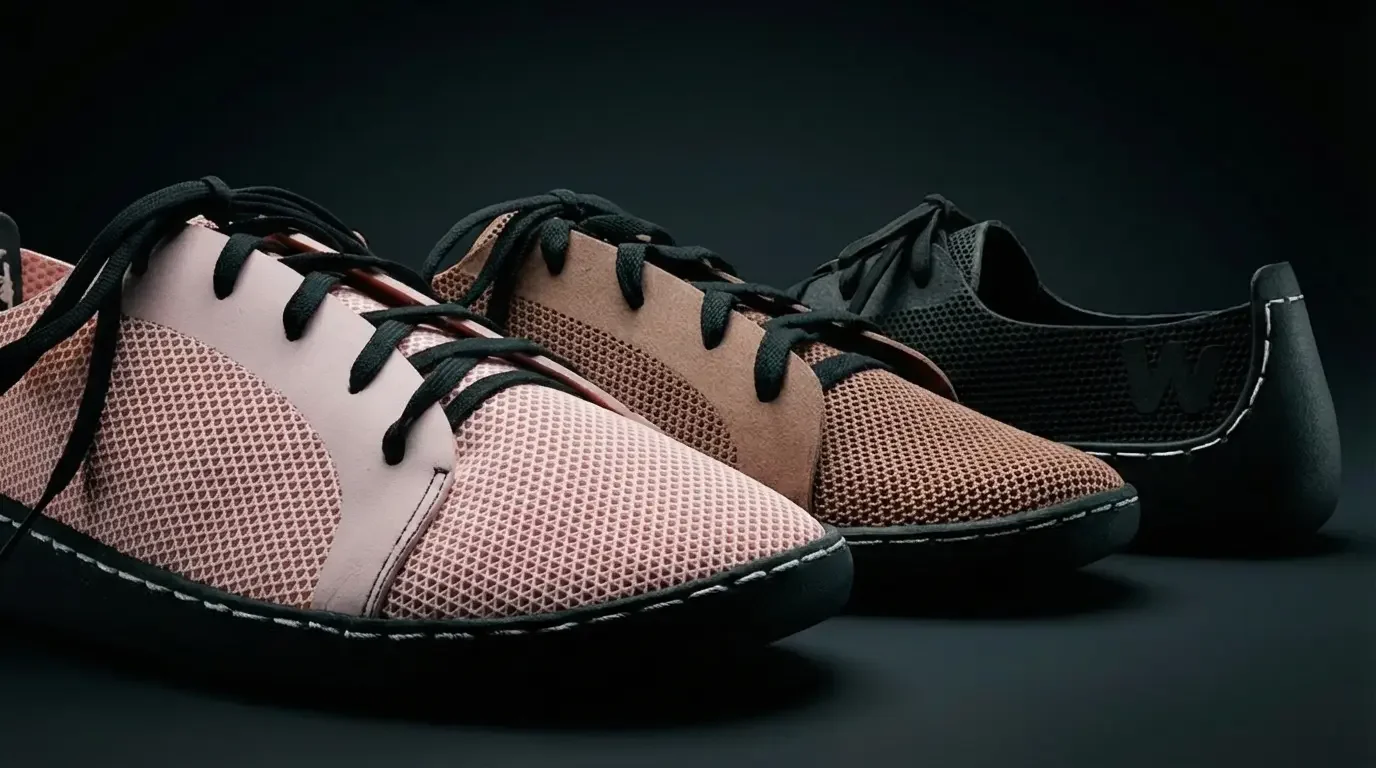
The story of METIS: Rethinking how footwear should be made.
Why we rejected the industry standard of monolithic 3D printed shoes to create METIS: a scalable, modular, and closed-loop footwear manufacturing system.
METIS did not start as a product, but more as a problem we rebelled against.
For over 5 years, we have been researching, testing and developing 3D-printed footwear manufacturing systems. Like much of the industry, we initially explored the idea of printing a shoe as a one-piece object, in one material, in one uninterrupted process.
In theory, this really was promising and simple. However, in practice, it exposed fundamental limitations.
Why Fully 3D-Printed Shoes Failed to Scale
Printing an entire shoe as a single element introduces structural, commercial and quality compromises that are difficult to overcome.
Shape constraints
To meet printability and mechanical strength requirements, shapes have to remain blocky and uniform. The result is closer to a shoe-shaped object than a shoe people instinctively recognise, adopt and wear.
Market adoption barriers
Even the most conscious consumers would consistently choose familiar silhouettes over non-familiar ones, regardless of clear sustainability benefits.
Design limitations
Monolithic printing typically limits footwear to one material and one colour, restricting design language, seasonal variation and aesthetic flexibility.
Manufacturing inefficiency and risk
Printing one full shoe can take 12-18 hours per pair. If a failure occurs late in the process, the entire unit is lost resulting in 150-250 grams material waste per failure, production output and a high environmental cost.
These issues made it clear that monolithic 3D-printed footwear would not help us with our vision.
Hybrid Approaches: Progress, but Not the Breakthrough
So we started exploring hybrid construction methods, combining 3D-printed components with traditional footwear elements, where 3D-printed outsoles were assembled with conventional upper knits.
This approach definitely delivered improvements:
A more familiar aesthetic.
Flexibility of design
Durability and performance
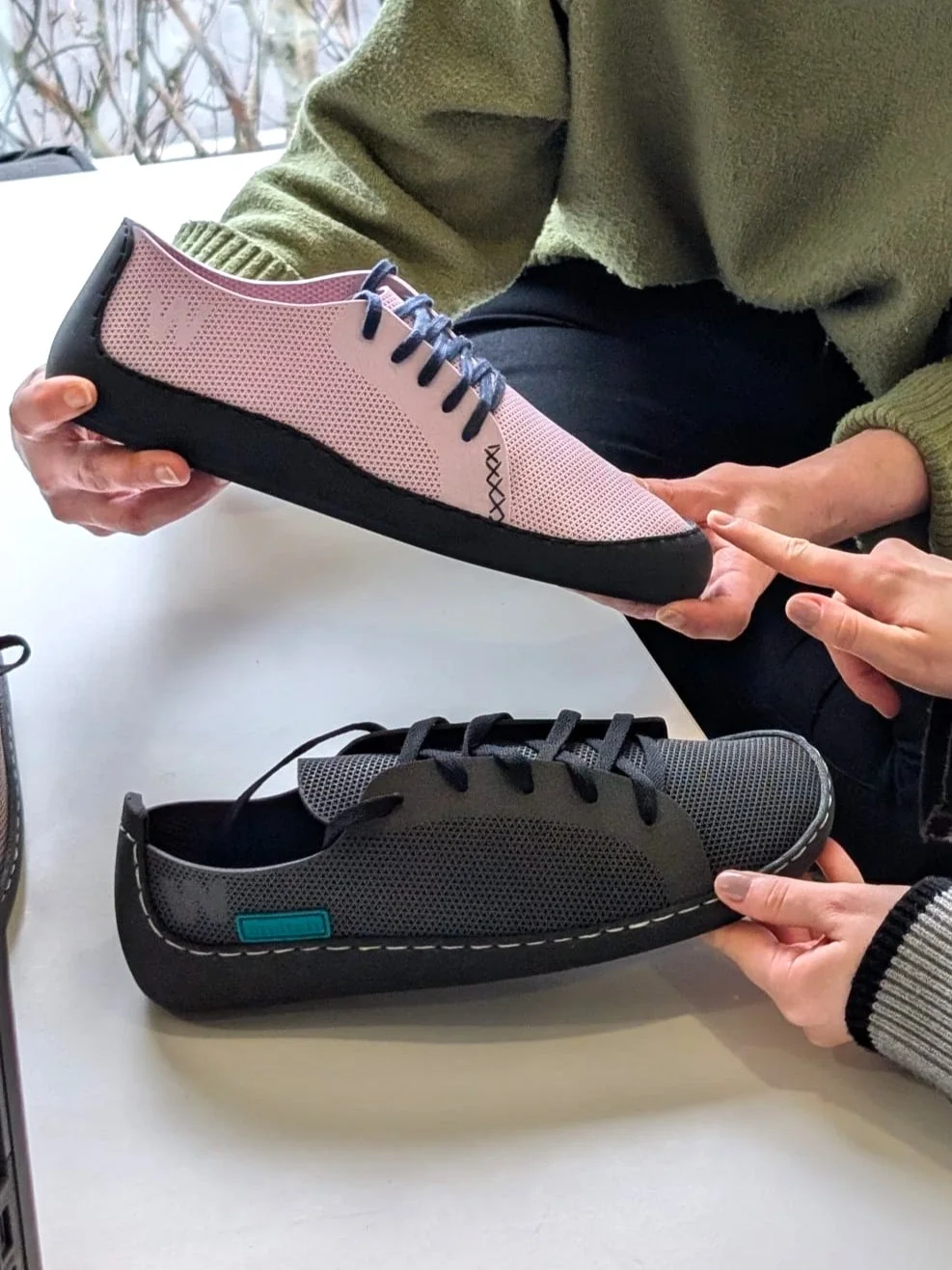
But key limitations still remained:
Assembly still relied on standard lasts, restricting custom fit adaptability. Sizing flexibility was limited to traditional systems with minimal repairability.
Recycling remained complex due to bonding materials and adhesives, and chemical processes were still required.
While visually compelling, hybrid construction did not solve the core problems of fit, recycling and scalable sustainability.
Rejecting Both Extremes
At this point, we were presented with two opposing options:
Option 1
Traditional footwear
High market acceptance, but high CO₂e footprint (~12-14 kg CO₂e per pair), complex, long, global supply chains and poor to zero recyclability.
Option 2
Fully 3D-printed footwear
Definitely striking manufacturing advantages, but poor adoption, limited design freedom, expensive and high production risk.
Don’t get us wrong - both these options are good, and there are many successful examples of how they can work on the market - we just knew we must create something new.
So, we did as we always do, we stepped aside and rejected both.
And asked a different question “Why not use 3D printing to print the entire shoe but instead use its advantages to solve the most complex part of the whole process, which is footwear assembly?”
METIS Construction Logic
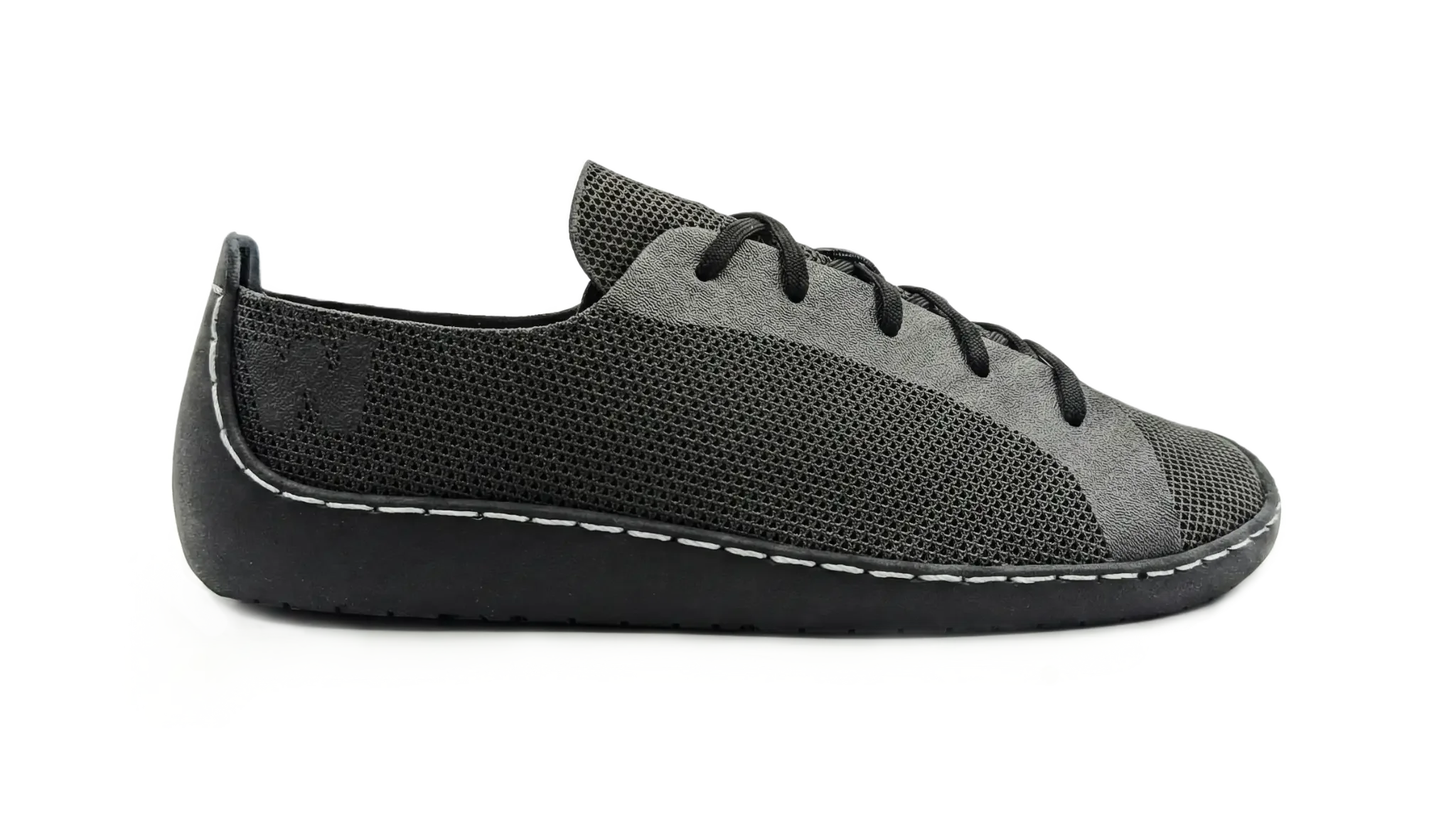
Rather than forcing everything into one printed block, we used 3D printing where it delivers the greatest values, the precision, repeatability, local, on-demand production, personalisation without tooling and material efficiency due to additive nature.
METIS introduces EasyStitch© - a simple modular stitched construction, enabled by 3D-printed components that guide and simplify assembly, but still has the durability and performance of traditional footwear.
This approach totally removes the need for lasts, cementing/glueing, heavy industrial machinery, chemically bonded layers, years of specialist training, molds and jigs.
Inspired by traditional cobbler stitching, but redesigned for modern manufacturing, the METIS EasyStitch© system allows anyone familiar with stitching, anywhere, to assemble the shoe with minimal tools and no adhesives or chemicals.
Assembly time per pair: 30 minutes with 4 to 6 elements, depending on shoe design.
A System, Not Just a Shoe
| Production model | On-demand, made-to-order |
|---|---|
| Manufacturing radius | Designed for microfactories within 10 to 500 km of the end customer |
| Failure impact | Modular construction limits scrappage to individual components rather than full shoe |
| Average weight per shoe | 211 - 339g per shoe, depending on size |
| Proven durability | 500,000 steps equivalent wear testing |
| Fit and comfort | Addressed through personalised width and length |
METIS as Our Lighthouse Product
METIS is the foundation of a broader footwear platform.
While additional products are planned across the range, METIS defines our design and manufacturing philosophy:
Repair and recycling over replacement
Modularity over monolithic design
Market adoption over technology push
Local production over global supply and overstock
METIS will always remain our muse and lighthouse product.
The Road Ahead: What Still Needs to Be Solved
We are fully aware of the challenges ahead.
Closed-Loop Manufacturing
By 2029, we aim to operate a fully functional closed-loop take-back system, where worn footwear is returned by customers, materials are recovered at >70% efficiency and customers have a discount on their next pair.
Material Performance After Recycling
Our target is to retain ≥95% of virgin material performance after recycling cycles, across durability, flexibility, abrasion resistance and other critical performance factors.
Our Non-Negotiable Red Line
Our objective is clear and measurable - less than 2 kg CO₂e per pair.
Current prototype footprint is estimated at 4.5 kg CO₂e per pair (cradle-to-gate)
We are convinced this is achievable. What we need is time, rigorous engineering, continued support from the EU, patience from the market and our customers.
The rest will inevitably follow.
METIS is not a finished product.
It is a system evolving toward circular, local, modular and scalable footwear manufacturing.
And we are only at the beginning.
| Product type | Modular stitched footwear |
|---|---|
| Manufacturing | On-demand, local microfactories |
| Assembly | No lasts, no adhesives, EasyStitch© technology |
| Width options | Standard or Customised |
| Average weight | 150 g (size 43) |
| Repairable | Yes (modular replacement) |
| Recyclable | Designed for closed-loop recycling |
| Current CO₂e footprint | 4.5 kg CO₂e per pair |
| CO₂e target | <2 kg CO₂e per pair by 2029 |
METIS Key Facts at a Glance
Looking for a sustainable, custom-branded manufacturing solution?
The METIS platform is now open for collaboration. We enable forward-thinking brands to use our modular architecture as the foundation for their own footwear collections.
To learn how METIS can power your next product line, leave your email below and our team will be in touch shortly.